
A missing dimension in red blood cell function
Red blood cells (RBCs) are responsible for delivering oxygen from the lungs to tissues, yet clinical diagnostics primarily assess static properties such as haemoglobin concentration, cell count, and morphology. These measurements provide an estimate of oxygen-carrying capacity, but they do not capture how efficiently oxygen is exchanged during circulation. As a result, a key determinant of physiological function—oxygen delivery—is not directly measured in routine practice.
Oxygen delivery is a kinetic process
Oxygen transport by RBCs is inherently dynamic. During their brief transit through capillaries, red cells must rapidly release oxygen to surrounding tissues. This process depends not only on how much oxygen is bound to haemoglobin, but also on how quickly it can be unloaded.
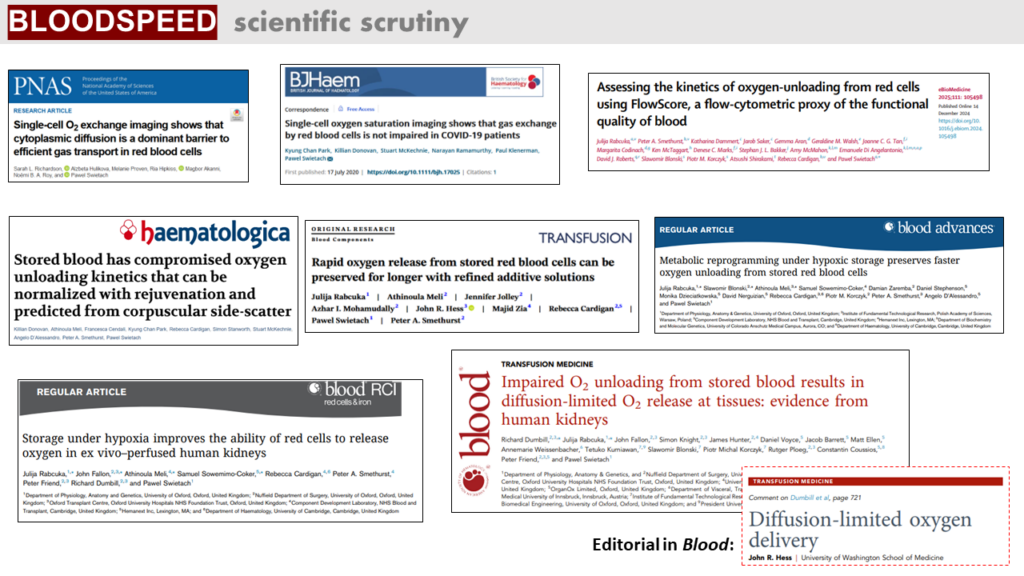
Our research has shown that oxygen exchange is limited by physical and biochemical constraints within the cell. In particular:
- Diffusion through the cytoplasm imposes a significant barrier to oxygen movement
- Cell geometry determines the diffusion pathlength
- Haemoglobin concentration and metabolic state influence binding and release kinetics
These factors combine to define the rate at which oxygen can be delivered, introducing variability in RBC performance that is not reflected in conventional blood tests.
Functional heterogeneity of red blood cells
Red blood cells are not functionally identical. Even within a single blood sample, there exists a distribution of oxygen-handling properties arising from differences in cell age, shape, and metabolic condition.
This heterogeneity becomes particularly relevant in clinical contexts:
- Inherited anaemias alter cell morphology, affecting diffusion pathways
- Stored blood undergoes biochemical and structural changes that impair oxygen release
- Critical illness and inflammation can modify red cell function
These changes can lead to impaired oxygen delivery despite normal haemoglobin levels, highlighting the limitations of relying solely on conventional indices.
From cell kinetics to tissue oxygenation
The physiological importance of oxygen-handling kinetics extends beyond the cell. Our work demonstrates that the rate of oxygen release from RBCs directly influences oxygen extraction at the tissue level.
In experimental models of organ perfusion, slower oxygen unloading reduces tissue oxygenation, indicating that oxygen delivery can become diffusion-limited, rather than purely dependent on blood flow or oxygen content. This challenges the conventional assumption that oxygen exchange is always rapid relative to capillary transit time.
Measuring oxygen exchange directly
Advances in microfluidics and imaging now make it possible to measure oxygen exchange in individual red blood cells under controlled conditions.
BloodSpeed applies:
- Microfluidic control of oxygen environments to simulate rapid transitions between oxygenated and deoxygenated states
- Time-resolved optical imaging to track haemoglobin oxygenation in real time
- Quantitative analysis to extract rates of oxygen loading and unloading
This enables direct measurement of oxygen-handling kinetics at single-cell resolution, providing a functional readout of RBC performance rather than relying on indirect proxies.
Toward functional blood diagnostics
By quantifying how efficiently red blood cells exchange oxygen, BloodSpeed introduces a new class of functional diagnostic metrics. These measurements provide information that is:
- Physiologically meaningful — directly related to oxygen delivery
- Mechanistically grounded — linked to cell structure and metabolism
- Actionable — relevant to clinical and operational decision-making
This approach opens new opportunities to improve diagnosis, optimise transfusion practices, and evaluate emerging blood technologies.
Building the evidence base
BloodSpeed is now being deployed across clinical and research environments to generate real-world evidence linking oxygen-handling measurements to clinical outcomes and operational decisions.
As this evidence base grows, functional assessment of red blood cells has the potential to complement existing diagnostics and support a more complete understanding of blood physiology in health and disease.